
Auto wochen am Winter: 5 Feeler, déi d'Streiselz uweisen léisen
Daniel von Detailing1 |


Koch-Chemie × COLOURLOCK
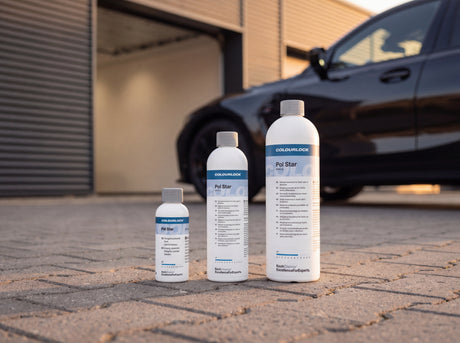
COLOURLOCK "Pol Star" Reinigerkonzentraat fir Textil, Léi & Alcantara 1000 ml / 1 Liter
pH-neutral cleaner concentrate for fabric, Alcantara & smooth leather
Koch-Chemie × COLOURLOCK
COLOURLOCK "Pol Star" Reinigerkonzentraat fir Textil, Léi & Alcantara 250 ml
pH-neutral cleaner concentrate for fabric, Alcantara & smooth leather
Koch-Chemie × COLOURLOCK
COLOURLOCK "Pol Star" Reinigerkonzentraat fir Textil, Léi & Alcantara 100 ml
pH-neutral cleaner concentrate for fabric, Alcantara & smooth leather
Koch-Chemie × COLOURLOCK
COLOURLOCK "Pol Star" Reinigerkonzentraat fir Textil, Léi & Alcantara 5 Liter
pH-neutral cleaner concentrate for fabric, Alcantara & smooth leather
How do you get Alcantara clean without the pile turning hard, patchy or uneven? Take the loose particles off first, check the material and its colour fastness, then work whole connected panels with very little moisture. COLOURLOCK Pol Star covers the deeper clean you can dial in; the dry brush handles the week-to-week care.
Cleaning Alcantara means taking an open-looking microfibre back to clean, evenly and on as little water as you can get away with, without soaking it through or matting the pile down with friction. Original Alcantara is polyester and polyurethane – it is neither smooth leather nor classic suede. So leather cream, leather oil and colour-refreshing leather products do not go on this surface on a hunch.
The first mistake usually happens at the product shelf. Alcantara feels velvety and looks a lot like suede, but technically it sits somewhere else entirely. That characteristic surface comes from very fine fibres. Leather care is built to feed natural leather fibres or protect a finish; on microfibre it can leave a film instead, glue the pile together and hold dust.
The wording in a classified ad is no material diagnosis either. In cars, "Alcantara", "microfibre" and "velour" get used loosely for one another. So check the spec list, the care instructions from the vehicle or furniture maker, and a hidden spot. If there is no clear label, you treat the surface as a delicate microfibre to start with: dry, sparing and no leather cream.
With genuine Alcantara, regular dry care is the biggest part of the plan and far more than a cosmetic extra. The official care advice starts with dust removal by soft brush, dry cloth or vacuum. For the weekly pass, a lightly dampened white cotton cloth is enough once you have de-dusted. White earns its keep here: it transfers no dye of its own and it shows you whether colour or dirt is coming away.
That does not make every darker patch a job for chemistry. On steering wheels and bolsters, touch and pressure can lay the pile all one way. Brush a dry test zone up gently. If the look changes with the direction you brush, what you are seeing is mostly fibre lay. If the spot stays tacky, greasy or clearly darker, a clean is the likelier answer. Missing fibres or areas rubbed bare, on the other hand, will not brush clean.
Dust, a fresh stain and a large shiny contact zone all look equally neglected, yet they do not call for the same opening move. Go at every blemish wet straight away and you turn a small finding into a visible clean patch. The breakdown below keeps the job as small as it can be.
| Finding | First step | Where you stop |
|---|---|---|
| Loose crumbs or dust | Vacuum, then lift the pile with a soft brush in several directions | If the look settles down dry, no cleaner is needed at all |
| Fresh local stain | Lift the excess, work from the outside in and never pour cleaner straight on | Stop rubbing the moment the stain travels or the area goes much darker |
| Large contact soiling | Clean the whole panel or material section evenly | Stop at colour transfer, a tacky surface or damaged pile |
With a spill, lifting comes first and spreading never does. A clean, absorbent white cloth goes on and gets swapped before it saturates. Thick residue comes off carefully with a spoon or a plastic edge. The official stain advice for Alcantara works from the outer edge inwards so the stain does not creep any wider.
An older stain asks more of you, because nobody knows what caused it. Water-soluble residue, grease, paint and adhesive do not behave the same way. Pol Star is the cleaner in this collection, not a blanket promise for every stain chemistry going. If a small, tested application shows no change you can read clearly, a stronger dilution is rarely the right answer. At that point the type of stain or the material damage has to be pinned down first.
Matted pile needs an honest limit too. Cleaning can release bound soiling and let the fibres move again once they dry. What it cannot do is replace fibres that have worn away. If a frequently touched spot stays smooth although it is clean, dry and carefully brushed, you are most likely looking at wear rather than leftover dirt.
COLOURLOCK Pol Star cleaner concentrate is the step in this collection for a deeper clean on Alcantara, textiles and suitable leather surfaces. Koch-Chemie describes the cleaner as neutral and gives a dilution of 1:5 to 1:20 depending on how dirty the surface is. So the concentrate does not get sprayed neat onto a seat by feel.
The range between 1:5 and 1:20 is not a power dial you turn to maximum as a precaution. A milder mix suits lighter dirt; heavier soiling can call for a stronger one. What decides it is still the test patch, the colour fastness and how the material takes it. Mix only as much as you need, mix it clean, and label the spray bottle so no unknown concentration lands on a delicate surface later.
Keep your mixing water and your tools clean as well. A bucket that had wheel cleaner or plastic dressing in it is the wrong shortcut for a pale seat centre. Use your own measuring jug, a clean bottle and light-coloured cloths where you can spot colour transfer straight away. Turn the cloth the moment that side has visibly picked up dirt. Otherwise you push the loosened film around and mistake the darker panel for a stain that wants yet more cleaner.
On a car seat you meter the working solution onto a microfibre cloth, a suitable sponge or a microfibre mitt. Koch-Chemie mentions the spray bottle too, but in a tight interior the tool is usually the stage you can steer better: seams, plastic trim, displays and the smooth leather next door get no stray mist. The tool should work damp, not drip.
Work with the main fibre direction and little pressure. Fine foam lamellae pull the dirt out of the fibre; hard scrubbing is not part of it. Product residue and released dirt come off with a damp, well wrung-out cloth. On larger surfaces that suit it, a wet/dry vacuum can help with the pick-up. Here too, the point is not to put in so much liquid that the foam core, the bonding or the seams soak through.
Pol Star is not supposed to leave water marks and, the maker says, keeps the original impregnation intact. That is still no free pass for over-wetting one spot: visible edges do not come down to the product alone. Unevenly released dirt, different amounts of moisture or residue down in the foam can all change the way it dries. Even passes and clean cloth sides matter more than a second heavy application.
If you want to clean Alcantara, work to natural borders. On a seat that means seams and material changes, on a door card a complete insert, on a sofa a single cushion or panel. Inside that area the method stays constant: same dilution, similar pressure on the tool, overlapping passes and a fresh cloth side at regular intervals.
After the dry vacuum, start on the least conspicuous side of the section. Work small, overlapping fields and lift the released dirt each time before it dries back in. The visible problem spot can have a little more attention, but not a completely different amount of moisture. Otherwise the stain does go lighter and its edge comes up all the sharper.
On a steering wheel, driving safety is in play as well. Cleaner does not get sprayed on directly, liquid must not run into buttons or gaps, and the rim has to be dry through and grippy before the next drive. If the surface is already shiny, hard or thinned out, cleaning it again brings no new pile back. A clean, worn steering wheel is a different finding from a dirty one.
On seat faces, seams and airbag zones deserve a light touch. Vacuum from a distance, keep liquid away from seam openings and avoid hard brushwork on thread and edges. An open or damaged safety seam has no place in a cosmetic cleaning attempt. It needs a professional check before the area takes any more load.
Between passes, nothing gets decided while it is wet. Lift the residue, rough the pile back out and let the surface dry completely. Only then can you see whether dirt is still there, whether the fibre direction is simply changing, or whether a second treatment makes sense. That pause is part of the clean – not time lost.
While you are working, almost every treated spot looks darker. All that tells you at this stage is that the microfibre is wet. Dry Alcantara in the air, with no hot air gun and no direct steam. On a car, open doors and normal air movement do the job; seat heating or strong local heat does not speed things up evenly.
Once the area is dry, lift it gently with a clean, soft-bristled brush. Brush from several directions, then compare the look from your normal viewing angle. A good result is not mirror-flat. The surface reads more evenly, feels dry and shifts its tone slightly with the direction of the pile.
Check a white cloth for residue as well. If it stays clean and the surface feels neither tacky nor soapy, the released dirt has plausibly been lifted. Residue you can feel calls for a careful pick-up pass with a well wrung-out cloth rather than another dose of cleaner. More product would only make the film you already have bigger.
For ongoing care you go back to the dry routine after that. Vacuuming regularly stops particles being pressed into the pile every time somebody touches it. A lightly dampened white cotton cloth can handle the in-between care. Leather care products stay out of it; on microfibre they build no useful reserve.
With open-pored leather or classic nap leather, the COLOURLOCK guide by leather type takes you down a different material route. For more textile cleaners, the sorting sits under textile cleaners. That keeps the decision on the material instead of on a product name that happens to sound similar.
Direct steam, chlorine bleach, aggressive solvents and hard rubbing have no place in normal Alcantara care. The material's maker also warns against excessive heat. Those limits matter most in a car: a small area is quickly overworked, and bonding, foam or neighbouring parts can react differently from the microfibre you can see.
Home remedies rarely lift only the stain, either. Oily mixes bind fresh dirt, coloured cloths can bleed, and an unknown share of solvent can change the surface. If you cannot place the type of stain with any certainty, a professional clean comes cheaper than an attempt that changes colour or fibre for good.
Cleaning ends where material is missing. Burn holes, cuts, open seams, delaminated backing and contact zones rubbed bare need repair or replacement. The same goes if the test patch gives up colour, stays hard after drying or the bonding shifts. None of those are signals for a second, stronger round.
The COLOURLOCK cleaners for upholstery and Alcantara sort the available cleaning products; the COLOURLOCK brand world shows the neighbouring leather, textile and repair systems. For this collection the buying decision stays deliberately narrow: Pol Star fits when a surface identified as Alcantara or suitable microfibre needs more than dry care and can be worked with metered moisture.
The finish reads through your fingertips: the pile moves again, the white cloth stays clean and the seat looks calm from a normal viewing angle. None of that takes a maximum carpet of foam. If the small intervention is enough, it stays small; if abrasion shows up, the clean ends at that honest material limit.
Zu viel Auswahl? Lass dir bei Alcantara — COLOURLOCK helfen:
Detailing1 bei Google als bevorzugte Quelle hinzufügenNee. Original Alcantara ass eng Mikrofaser aus Polyester an Polyurethan. D'Samtoptik ähnelt Rauleder, awer Léidercrème an Léideröl kënnen de Flor verkleeben. Bei onklarrer Materialangab gëlten zäuerst d'Pflegehinweis vum Faarfuerds-, Mëbel- oder Bekleidungsfabrikant.
Net ouni ausdrécklech Materialfreigab. Pflegecrémer an Öler sinn fir Léiderfasere oder Léiderfinishs dengt an kënnen op Mikrofaser en eng Schmutzbinden Film bilden. Fir d'laufend Pflege rächen meist Absaugen, eng weich Brusch an en liicht ungefäuchts wéissen Baumwolltuch.
Koch-Chemie gëtt ënnerlech Verschmutzung 1:5 bis 1:20 un. Fänkt net automatesch mat der stärkster Mischung un: Prüeft Faarfesteek un Materialverträglichkeet un enger verdeckter Plaz, beschriftet d'Arbeitslösung an gëtt si kontrolléiert op d'Werkzeug.
Frësch Flécker gëtt zäuerst vun Usser an en Usser ufgemmen. Fir d'féicht Reinigung ass ëmou eng zämmengangene Fläch bis zur nächster Näht oder Materialkante sinnvoll, fir datt ënnerschiddlech Feichtheet an gelöste Umgéigenschmutz keng sichtbarem Hof erzéigen.
Direkten Dampf gëtt vum Materialfabrikant net empfielt. Och Chlorbleich, aggressiv Léisemittel, kräfteg Reeben an iwwermässig Hëtze geeren net an d'normal Pflege. Polsterkärn, Klebung, Nähte an angrenze Bauteile däerfen net durchnäit ginn.
Looss d'Fläch zäuerst vollstaendig un der Loft trocknen an richt de Flor dann mat enger sauber weicher Brusch op. Bleift eng Kontaktzoun blank oder feelen Fasere, handelt et sech méi um Verschleiß wéi um Reschtsschmutz; weider Reinigung baut keng Flor nei op.
1. Material bestätegen an droen reinéigen: Prüef d'Pflegekennzeichnung an d'Faarfächtheet. Sauge Krümmen an Staub of oder lös si mat enger weicher Buerst of.
2. Pol Star passend verdünnen: Mëtt je no Verschmutzung eng Mëschung tëscht 1:5 an 1:20 un. Benotz eng rein, beschrift Flaschn.
3. D'Aarbeitsfeld un Näien begrenzen: Gitt d'Léisung op Tuch, Schwamm oder Mikrofaserhandschong an bearbeitt eng komplett Bahn mat weng Drock.
4. Schmutz an Produktreste ufrehmen: Aarbeitt an Faserrichtung an nimt de gelöste Belag mat enge feucht, gutt ausgedrenktem wäissen Tuch op.
5. Luftdréien an de Flor ufrechten: Bewert d'Fläch ëmmer ganz droen. Buerst d'Fasere denno mat weiche Borsten aus verschiddene Richtungen aus.
Informatiounen: Keen direkt Dampf, keng Chlorbleich, keng aggressiv Léisungsmëttel an keng erzwungen Hëtze. Bei Faarfverdréien, ënneren Näien, ofgelöster Kaschéierung oder feelende Fasere endet d'normal Reinigung.
Daniel von Detailing1 |

Daniel von Detailing1 |

Daniel von Detailing1 |

Daniel von Detailing1 |

Daniel von Detailing1 |

Daniel von Detailing1 |

Daniel von Detailing1 |

Daniel von Detailing1 |

Daniel von Detailing1 |

Daniel von Detailing1 |

Daniel von Detailing1 |

Daniel von Detailing1 |