Ingedroogde boomhars van de autolak verwijderen: eerst losweken, dan verzegelen
Daniel von Detailing1 |


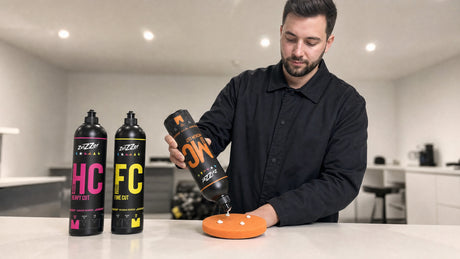
Pads, polish en autoverzorging van het merk.

ZviZZer
Graphene Ceramic Coat Keramische coating
Grafeen-keramische coating met 48 maanden standtijd en antistatisch
ZviZZer ceramic coatings are two hard paint coatings that last for years after polishing: the classic Paint Ceramic Coat with 30 to 36 months of protection and the harder, graphene-reinforced Graphene Ceramic Coat with 42 to 48 months. You choose based on the desired durability and effort.
ZviZZer ceramic coating is a liquid paint coating that, once cured, forms an ultra-thin, glass-like lattice on the clear coat and bonds with it chemically. This layer lasts for years instead of months, causes water to bead up, and makes the paint smoother and more scratch-resistant. ZviZZer offers two coatings in this category: Paint Ceramic Coat as a balanced ceramic and Graphene Ceramic Coat as a harder, graphene-reinforced top-tier product.
Pro-tip from Detailing1: The most expensive mistake with coatings happens before the first drop is applied. We often see coatings applied to paint that has been washed but not polished or degreased — and then the swirls are locked in for three or four years, or the layer doesn't bond fully and flakes off after months. Polish first, then degrease with isopropanol, then coat. One minute of wiping with paint prep determines years of durability.
The one difference that separates a ceramic coating from wax and spray-on protection is of a chemical nature. A coating bonds to the paint; everything else just sits on top.
When curing, a ceramic coating forms a silicon-oxygen network — an ultra-thin, glass-like lattice that couples chemically to the clear coat rather than just lying on it physically. It is precisely this firm bond that explains why coatings are measured in years, while a wax as a superficial film disappears after months. The Graphene Ceramic Coat complements this network with a hexagonal graphene molecular structure, which the manufacturer describes as a tough, crystalline protective shield.
In practical terms, this provides a hard, smooth, anti-stick surface. Dirt, insects, bird droppings, and road salt find less grip, and the strong hydrophobicity causes water to roll off in beads instead of drying as a film. For you, this means fewer water spots after rain, easier drying, and fewer micro-scratches when drying with a towel. The Graphene Coat also adds an antistatic effect that repels fine dust and keeps the car cleaner between washes.
How this protection class compares to waxes and quick toppers, and the order in which everything builds upon each other, is explained in the overarching vehicle care section. There, the entire protection hierarchy from a few weeks to over four years is presented side-by-side. This page focuses on the top level — the two coatings that last for years.
ZviZZer offers two coatings, and the choice between them is essentially a matter of durability, hardness, and hydrophobicity. Both are ceramic, but the Graphene version is the more uncompromising variant.
The Paint Ceramic Coat is the classic, balanced ceramic — a hybrid silicon-polymer hard coating. It lasts 30 to 36 months or about 30,000 km, makes the clear coat about 60 to 65 percent more scratch-resistant, and is chemical-resistant in the pH range of 3 to 12. It thus reliably protects against oxidation, road salt, acids, insects, bird droppings, tar, and UV rays. For most vehicles that need solid and long-lasting protection, it is the right choice.
The Graphene Ceramic Coat is the top-tier product. Thanks to the incorporated graphene molecules, it lasts 42 to 48 months and up to 40,000 km — about twelve months and 10,000 km longer than the Paint Coat. The hexagonal structure makes it harder and more scratch-resistant than a pure ceramic layer, the contact angle and thus the hydrophobicity are higher, and the antistatic effect keeps dust away. It is the strongest ZviZZer coating.
An honest note on hardness: You will deliberately not find a hardness rating like 9H at ZviZZer, neither for the Paint nor the Graphene Coat. The manufacturer does not state an official pencil hardness value, and we are not going to invent one here. The statement that is reliable is: The Graphene Coat is harder and more scratch-resistant than the classic ceramic coat, and both are significantly harder than untreated factory paint. There is no need for further promises.
A coating preserves exactly the condition it finds. That is why half the work is not in the application, but in the preparation of the paint.
The surface must be washed, decontaminated with clay, polished, and then degreased with paint prep or isopropanol. Each of these steps has a reason. The clay removes rail dust and embedded particles from the clear coat, the polish removes swirls and holograms, and degreasing removes residual polishing oils that would otherwise act as a separating layer between the coating and the paint. For you, this means: without a grease-free surface, the layer will not bond fully, and the promised durability will be significantly shorter.
Why polishing is mandatory beforehand is the most important point in the entire category: A coating does not hide paint defects; it freezes them. If swirls or dull spots are under the layer, they remain visible for the entire duration — a reflective ceramic surface may even make them more apparent. Therefore, correction happens beforehand, for example with a one-step polish; afterward, only protection is added.
Safety when working requires plain speech instead of panic: both coatings are solvent-based and flammable. In practice, this means working in a well-ventilated environment, staying away from ignition sources, and wearing gloves. It is not much more effort, but it is part of being honest about what you are handling.
With application, there is a fine line between a clean result and high spots. Both coatings need to be processed quickly, thinly, and with the correct flash-off time.
For the Paint Ceramic Coat, you apply 10 to 15 drops onto the applicator block wrapped with the applicator cloth and apply it thinly section by section in a cross-hatch pattern, i.e., overlapping in two directions per component. Then you let it flash off for one to three minutes; during this time, high spots become visible as shimmering areas. Afterward, you buff it out with a clean microfiber cloth until the surface is streak-free.
With the Graphene Ceramic Coat, you work on the same principle with two cross-hatch passes per panel, a short flash-off time, and subsequent buffing with soft microfiber. In both cases, the included microfiber cloth must be kept fresh and clean — a cloth that has already picked up coating will smear residue over the next area and create exactly the streaks you want to avoid.
The two classic mistakes lie at the ends of the scale. Too much material or buffing too late leaves high spots and streaks that are difficult to remove after curing. Working too hectically or too dryly, on the other hand, causes the coating to set before you have distributed it. The solution is to work panel by panel and never apply to a larger area than you can cleanly buff out within the flash-off time.
After application, the coating needs rest. It is dry to the touch after a few hours; full curing takes days. During this time, avoid water and washing; with the Paint Coat, the first 24 hours are particularly critical — no rain, and do not apply in direct sun, because the coating will flash too quickly. In our experience, a dry, covered night after application is the easiest insurance for full durability.
Ceramic coating is the top level of the ZviZZer protection hierarchy — but it is not the right choice for everyone and every purpose. An honest comparison with the lower tiers is part of this.
Compared to spray-on protection, the difference is primarily effort versus durability. A coating requires polishing, degreasing, hours of application, and days of curing, but lasts for years. A spray sealant is sprayed on and buffed out in minutes, but only lasts for weeks to a few months. It does not replace a coating; it complements it as a refresher — which spray type is suitable as a topper over a coating is explained in the spray sealant section. The biggest factor in coating durability is precisely this maintenance.
Compared to wax, the difference is the bond and the look. Wax sits on top physically, gives many dark paints a warm, deep shine, and is the simpler ritual to do by hand — but it only lasts 4 to 12 months, depending on the type. A coating bonds chemically, lasts for years, and provides a crystal-clear, rather cool shine. If you prefer the classic wax look and easy hand application, you are better off in the wax category.
And one limitation that applies to all three classes, which we prefer to state beforehand: None of these layers is stone-chip protection. The Graphene Coat is harder than any standard ceramic, and the Paint Coat makes the paint noticeably more scratch-resistant — but against a stone chip on the highway, only a paint protection film helps, not a coating. A coating does not stop a stone and does not fill existing scratches. This expectation leads to disappointment afterward if it is not corrected beforehand.
The decision between the two coatings can be reduced to two questions: How long do you want to not worry about protection, and how uncompromising should the protection be?
If solid, balanced ceramic protection with deep gloss for a good two and a half to three years is enough for you, the Paint Ceramic Coat is the right choice. It covers what most vehicles need — a hard, hydrophobic surface, chemical resistance, significantly more scratch resistance than factory paint — without you paying for reserves that you do not fully utilize. For an everyday car that is maintained but not celebrated, it is the sensible decision.
If you want maximum hardness, the highest hydrophobicity, the antistatic effect, and the longest durability of up to four years, the path leads to the Graphene Ceramic Coat. It is the right choice for dark paints, enthusiast vehicles, and anyone who wants to do the work once without compromise and then have peace of mind for a long time. The approximately twelve months of additional durability and the dust-repellent effect justify the effort if the car is worth it to you.
For whom a coating is generally not the right tool: for beginners without proper preparation, because the high-spot risk and the requirement to polish are real hurdles. Anyone who does not want to or cannot polish and degrease the paint will lock in defects and never achieve the promised durability — for them, a wax or a spray sealant is the more honest starting point. A coating rewards care, and it punishes shortcuts.
From our practice, the typical setup looks like this: polish the paint, degrease with isopropanol, apply the chosen coating as a foundation, and let it cure completely. Afterward, maintenance runs almost by itself — wash gently and occasionally use a spray topper after washing to refresh the hydrophobicity. That is how you get the upper range of durability out of both coatings and have done the work properly once instead of having to reapply every year.
Te veel keuze in Keramische Coating van ZviZZer? Laat je helpen kiezen:
Detailing1 toevoegen als voorkeursbron in Google
Daniel von Detailing1 |

Daniel von Detailing1 |

Daniel von Detailing1 |

Daniel von Detailing1 |

Daniel von Detailing1 |

Daniel von Detailing1 |

Jasper von Detailing1 |

Daniel von Detailing1 |

Daniel von Detailing1 |

Jasper von Detailing1 |

Daniel von Detailing1 |

Daniel von Detailing1 |