Today: Clear coat holds just eight microns of reserve. Shop polish

From the blog: How often you can polish without losing clear coat. Read the guide

Weather: Three dry days in a row from Sunday. Paint protection

Right now: Tree sap hardens into the paint in two days. Pre-cleaners

Best seller: Koch-Chemie Vorreiniger B "Vb" lifts sap and bugs. View product

New: NIGRIN "Alu Monster" turns red on brake dust. View product

Clearance: INNOVACAR is running out while stock lasts. Shop the brand

Instagram: Today the result of hand versus machine. Follow us

Advice: How often is too often to polish? Ask us. Start a chat

Support: Shipping and returns in the help centre. Go to help centre

Buyer protection: Real reviews on Trusted Shops. Read reviews

For businesses: Detailing1 PRO bills net of VAT. Learn more

Tires rim

(70 products)
At Detailing1, tyres & wheels bundles the routine at the wheel: wheel cleaner against baked-on brake dust, wheel sealant for a smooth, dirt-shedding surface and tyre dressing for the faded sidewall. The range runs from the acid-free cleaner with colour-change indicator through alkaline pre-cleaners to the acidic last-resort product and the ceramic coating. Brands on the shelf include Koch-Chemie, SONAX, TUGA Chemie, GYEON and D-CON.

View as

  • Koch-Chemie

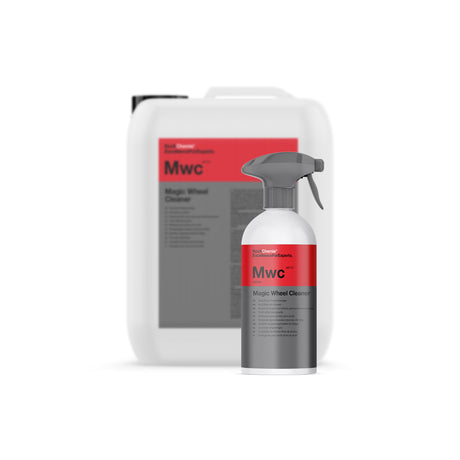
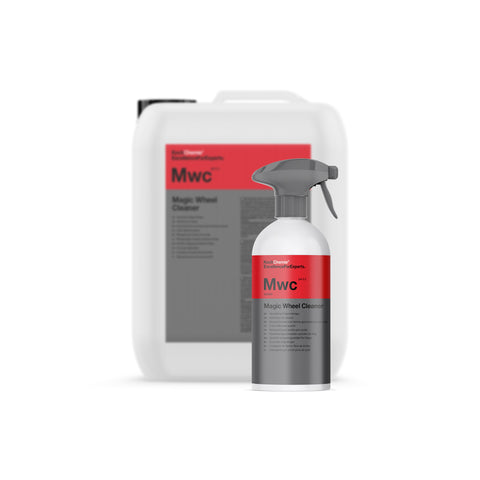
    Magic Wheel Cleaner "Mwc" Wheel Cleaner

    Acid-free wheel cleaner with color change for daily workshop use

    In stock (16× 500ml)
    Backordered (1× 10 liters)
    From 14,96€ 16,63€
    Inhalt: 500mlUnit price (29,92€ / l)
    View details
  • Koch-Chemie

    Plast Star "Pss" Premium Plastic Care Silicone Oil-Free

    Premium care for exterior plastic and rubber without silicone oil

    In stock (19× 1000 ml / 1 liter · 1× 10 liters)
    From 18,29€ 19,96€
    Inhalt: 1000mlUnit price (18,29€ / l)
    View details
  • Koch-Chemie

    Koch-Chemie Kcu Tyre Foam "Rfs" Tyre Care

    Quick and effective tire care for long-lasting shine

    In stock (2 units)
    From 13,30€
    Inhalt: 600mlUnit price (22,17€ / l)
    View details
  • Koch-Chemie

    Felgenreiniger extrem "Fe" wheel cleaner

    Salzsäurebasierter Profi-Felgenreiniger für eingebrannten Bremsstaub

    In stock (1× 22kg)
    Pre-order (11kg)
    From 97,61€
    Inhalt: 11kgUnit price (8,87€ / kg)
    View details
  • TUGA Chemie

    Alu-Teufel "Spezial"® (Green) Wheel Cleaner

    pH-neutral wheel cleaner gel with active indicator for all rims
    In stock (23× 1000 ml / 1 liter · 3× 5 liters)
    Pre-order (20 Liter)
    From 18,74€
    Inhalt: 1000mlUnit price (18,74€ / l)
    View details
  • Wheel cleaner, sealant and tyre care for the whole wheel

    What goes into looking after your tyres and wheels? Three steps, always in the same order. The wheel cleaner lifts the baked-on brake dust, a wheel sealant leaves the surface slick and dirt-repellent, and the tyre dressing brings the sidewall back to deep black.


    Wheel cleaners are your way into the hardest-working surface on the car. Brake dust isn't dust that settles on top — it's metal grit that flies off the disc red-hot and burns itself into the clear coat of the wheel. That's why the wheel gets its own routine: clean, seal, dress the tyre. This category pulls the three steps together and points you to the right sub-category from here.

    • Brake dust lands hot, not cold. When you brake, the pad drags across the grey cast-iron disc and throws iron filings outward that hit the wheel several hundred degrees hot. They don't bounce off, they dig in. That's exactly why shampoo and a sponge won't shift them any more.
    • Sealing shortens every wash that follows. A ceramic wheel sealant like the Koch-Chemie Ceramic Rims „Cr0.01" ceramic wheel sealant lasts up to twelve months and makes water and dirt bead off. For you that means the brake dust sits on top instead of keying in, and the wash turns into a rinse instead of a scrub.
    • Tyre and wheel are two materials with two needs. The wheel carries paint or a powder coat; the tyre is vulcanised rubber that bleaches out and goes grey under UV light. A one-for-both product exists, but the better route still runs over two steps. First the wheel cleaner, then the tyre care.

    Day-to-day from Detailing1: We keep getting questions about brown streaks that run down from the wheel over the sill after the first drive. The cause is nearly always tyre dressing on a tyre that never got cleaned first. Tyre rubber contains anti-ozone agents that slowly migrate to the surface and settle there as a brownish film. Put a dressing on top and it loosens that film, then the first shower spreads it across your paint. So always clean the sidewall with a tyre cleaner first, until the foam stays white instead of turning brown, and only put the dressing on once the tyre is dry.


    Brake dust is hot metal grit, not dust

    No other area on the car takes heat, metal, road salt and stone chips all at once. The wheel is the most heavily loaded surface you'll ever look after.

    It comes down to the brake. Every time you slow down, the pad presses against a grey cast-iron disc and wears material off both sides. What comes off is a mix of iron particles, carbon and metal oxides that flies outward at high speed and hits the inside of the wheel first.

    Temperature is the deciding factor. Brake discs hit several hundred degrees in everyday use, and a lot more on a spirited mountain run. On impact the particles are hot enough to briefly melt the wheel's clear coat and lodge in it. What you see afterwards doesn't sit on the surface — it sits in it.

    From there the particles keep corroding. Iron oxidises, gains volume and pushes against the coating from the inside. On light and silver wheels you spot it early as orange-brown dots; on anthracite wheels you feel the roughness before you see it. The tell: after a wash the wheel feels like fine sandpaper under your fingers.

    The tyre next to it has a completely different problem. It doesn't get dirty, it ages. Sunlight and ozone attack the polymer chains in the rubber, the sidewall loses its deep black and goes matt first, then grey. On top of that comes a layer of asphalt particles and road grease that works its way into the sidewall's texture.

    That double load is why this category is built the way it is. Cleaning lifts what's baked in. Sealing makes sure less keys in next time. Dressing gives the rubber back what the sun took away. Three jobs, three product groups, one wheel.

    Acid-free for the week, acid for emergencies

    Wheel cleaners differ less by brand than by where they attack. Three types cover the field, and two of them are enough for just about every day-to-day job.

    The acid-free group is the standard, and the only one you can put on any type of wheel without a second thought. The Koch-Chemie Magic Wheel Cleaner „Mwc" wheel cleaner is our best-seller in this category. It doesn't work through pH — it works through an active that chemically binds iron and turns purple as it does.

    That colour change isn't for show — it's your proof it's working. The active grabs every iron particle like a pair of pliers and pulls it out of the surface into the water film. In plain terms: where the wheel runs purple, there was metal; where nothing happens after five minutes, there's nothing left to get. The TUGA Chemie Alu-Teufel „Spezial"® (Green) wheel cleaner follows the same logic and is our best-selling wheel cleaner outside the Koch-Chemie line.

    Alkaline cleaners sit above pH 7 and go after the greasy road film that settles over the brake dust. They're the classic pre-cleaner on the wheel and work well on painted OE wheels. The Koch-Chemie Felgenblitz acid-free „Fb" wheel cleaner and the D-CON „V4" Wheelcleaner & De-Ironizer cover this ground, the latter with added iron binding.

    The third group is the acidic one, and it's a tool for the exception. The TUGA Chemie Aluminium-Teufel® (Red) wheel cleaner sits around pH 1 and dissolves sintered-on brake dust that acid-free products can't touch. It belongs strictly on wheels with an intact clear coat, gives no colour change and works by the clock, with a dwell time of one to three minutes.

    That's exactly why we file it as an emergency product, not weekly care. Polished, anodised or diamond-cut aluminium can't take acid — the surface stays matt afterwards and there's no getting it back. If you're not sure which coating your wheel carries, reach for the acid-free product and just extend the dwell time. The full range lives under wheel cleaners.

    The wheel routine starts before the wash

    The wheels come first — before the car itself gets washed. Flip that order and you'll do the job twice.

    There are two reasons. Wheel cleaner splashes when you put it on and when you rinse it off, and anything that lands on freshly washed paint you'll have to wipe down again. The second reason is temperature: at the start of the round the wheel is cold to the touch; after twenty minutes in the sun it isn't.

    Cold to the touch is meant literally. After a brisk drive a wheel quickly climbs past a hundred degrees, and on a surface like that the cleaner flashes off instead of reacting. Whatever flashes off leaves streaks behind. If you've no time to let it cool, rinse the wheel down cold first and work in the shade.

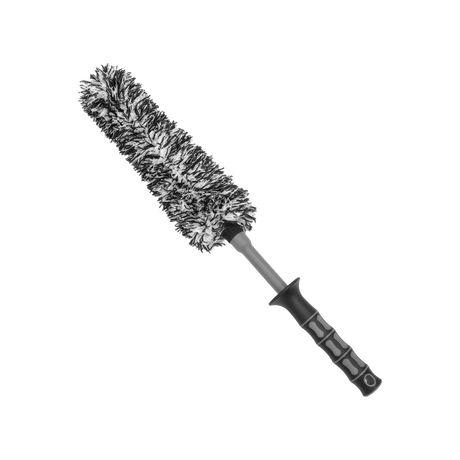
    Lay it on wet and work from the bottom up. The reason is physics: if the product runs into a dry area, it pulls visible streaks. Three to five minutes of dwell time is plenty with acid-free products; after that a wheel brush handles the gaps between the spokes, then the hose. When a wheel is really loaded, a second pass is the answer — not a longer wait.

    One wheel at a time, not all four at once. Four sprayed wheels means the first is already drying while you're stood at the fourth. The first time round, four wheels take you about thirty minutes. By the third time it's fifteen, because the rhythm of spray, wait and rinse has clicked.

    Then comes the car wash. How the rest of the routine plays out — from pre-wash through the wash mitt to drying — lives under car wash. If the baked-in metal grit is sitting in your paint too and not just on the wheel, the iron remover is the better tool for the bodywork.

    Sealed wheels keep the brake dust on top

    A wheel sealant doesn't clean — it changes the surface. Brake dust finds less to hold onto afterwards, and you notice it at every wash that follows.

    The mechanism is the same as on paint. The sealant closes the fine pores in the coating and forms a smooth, water-repellent layer over the top. A particle that hits a sealed surface has nothing left to anchor into. In practice: what used to need dwell time now comes off with the jet of the hose.

    With ceramic sealants you also get heat resistance. The layer of silicon compounds shrugs off the temperatures a wheel reaches in use, and that's exactly what sets it apart from a classic wax coat. The Koch-Chemie Ceramic Rims „Cr0.01" ceramic wheel sealant lasts up to twelve months and rides out acidic and alkaline cleaners while it's at it.

    For professional use there's the SONAX PROFILINE CeramicCoating „CC" Rim alongside it, built for detailers coating several sets back to back. If you'd rather keep the effort down, go for a wax-based option like the D-CON Wheel & Rim Wax „V2" wheel sealant, which goes on faster but needs redoing at shorter intervals.

    Timing decides how long it lasts. A sealant needs a chemically clean wheel, otherwise it locks the particles in instead of shutting them out. So the order is fixed: clean, go back over it with an iron remover, degrease, dry, and only then seal. Every step you skip costs you months of durability.

    The step pays off most right after a wheel change. The wheels are off anyway, you can reach the inner barrel, and that's where most of the brake dust sits. A set coated in spring comes through the summer cleaner than any set that's only ever cleaned after the fact. All the options are under wheel sealant.

    The sidewall needs cleaning before care

    Tyre dressing rarely fails because of the product and nearly always because of what's underneath. On an uncleaned sidewall no dressing lasts longer than a single drive.

    There are three layers stacked on the rubber. Road grease and asphalt particles make up the outer coat; underneath sit the remains of old dressings; and right at the bottom the anti-ozone agents migrate out of the rubber to the surface. That mix is what's behind brown streaks and dressing that looks blotchy after two days.

    The cleaner for it is mildly alkaline, not aggressive. The SONAX XTREME Tyre + Plastic Cleaner sits at pH 8 to 9, lifts greasy grime reliably and stays well clear of the values that make rubber brittle. It takes the neighbouring wheel-arch liners and sills along with it, which are polypropylene and handle the same treatment.

    Some elbow grease is part of it. A tyre brush with medium-stiff bristles pulls the grime out of the sidewall's texture, where chemistry alone only reaches the surface. The simple test: spray, brush, rinse and repeat until the foam stays white. As long as it runs brown, you're still working on the base, not the result.

    Only then comes the dressing, and that's where you choose the look. A water-based gel gives a deep satin-matt finish that looks like a brand-new tyre. Silicone sprays bring the wet high-gloss that pops in photos and picks up dust faster. Both are fair game, and both need the same clean base underneath.

    Two things stay off-limits. The tread never gets treated — no dressing belongs there. And overspray on the brake disc can, in the worst case, hurt your braking, so you spray onto the applicator, not at the wheel from half a metre away. The selection is under tyre care.

    Where you turn off from here

    Three questions steer you into the right sub-category: how heavily loaded is the wheel, what surface does it carry, and how much time do you want to put in per round.

    For normal everyday use and painted OE wheels, an acid-free cleaner with a colour change is the right answer. The Koch-Chemie Magic Wheel Cleaner „Mwc" wheel cleaner has the job fully covered and shows you, in that purple run-off, just how much metal was really in the surface.

    For polished, anodised or diamond-cut wheels the choice stays strictly acid-free. The TUGA Chemie Alu-Teufel „Spezial"® (Green) wheel cleaner is built for exactly that and takes the worry out of bare rim lips. Only when a set is genuinely sintered up after months without care do you reach for the acidic product — and then with gloves, goggles and a stopwatch.

    If what bugs you is how fast everything turns black again, the fix isn't a stronger cleaner — it's one step further on. A coating from wheel sealant shifts the work from every wash to one appointment a year. That's the point where cleaning turns into care.

    For the quick round in between, a spray product is often enough. The SONAX XTREME Ceramic Tyre + Wheel Detailer does the wheel and the sidewall in one pass and freshens up an existing sealant. It doesn't replace the deep clean, and it keeps the gap between two deep cleans comfortably wide.

    And if you want the whole path: the cleaners for every type of wheel are under wheel cleaners, the protection that follows under wheel sealant, the sidewall under tyre care. Read in that order, they add up to the complete wheel routine — and every single step saves work on the next.

    Too much choice in Tires rim? Get help picking: