



5 Care Products That Each Need Their Own Winter Storage Spot
At the end of October almost everyone rearranges their care shelf: the wash season is winding down, the canisters move into the garage, and the polish stays in the carport cupboard. Nights in Nordhorn are already sitting around 5 degrees this week, and an unheated garage drops below zero on cold nights. If you want to store your car care products properly, the answer to which bottle can take it sits in a section hardly anyone reads.
Storing car care products properly means taking section 7 of the safety data sheet seriously. Polish, acidic sprays, alkaline cleaners, solvent-based care and diluted cleaners each have their own rules there on frost, heat and what they can stand next to. Sort them into five groups and you won't lose a single bottle by spring.
1. Polish and wax separate for good after freezing
Polishes and many liquid waxes are emulsions of oil and water that only an emulsifier holds together, and that bond is exactly what often doesn't survive frost in the garage.
An emulsion is a mix of water and oil that doesn't really want to mix. The emulsifier wraps around every oil droplet like a shell and keeps it suspended in the water, much like a dressing that doesn't split. When the water freezes, ice crystals grow between the droplets and punch through that shell. How you spot it: after thawing, the polish is thin and clear on top, thick and lumpy at the bottom, and shaking doesn't bring the creamy consistency back.
That's why Koch-Chemie sets clear storage conditions in the safety data sheets of its cutting compounds. For the One Cut & Finish P6.02 and the Fine Cut F6.01 it says “Store at room temperature” and “Store in a dry place”, for the Heavy Cut H9.02 “Store in a cool place”, so cool, but not frozen. In the handbook for its coatings, GYEON says in essence that the bottle must neither freeze nor sit in the sun.
The fix is simple: polishes, waxes, leather care and anything creamy move indoors in November, into the cellar or the utility room. One box is enough. If a bottle has frozen anyway, let it thaw slowly at room temperature, never on the radiator, shake it for two minutes and check the consistency. If it turns smooth and even again, it's usually still good to use. In detailing forums the common experience is that it's mainly repeated freeze-thaw cycles that wreck the emulsifier.
If a clear layer stays on top or the polish feels gritty, it doesn't belong on your paint any more. In a separated cutting compound the abrasives sink and clump instead of working evenly spread. The risk is scratches and a patchy finish, and it only shows once the machine is already running on the paint. Measured against that, a half-full bottle is the smaller loss.
2. Acidic sprays need protection from frost according to the data sheet
Acidic quick detailers with limescale remover are among the most sensitive bottles on the shelf, because their safety data sheet explicitly calls for storage at room temperature and protection from frost.
For the Finish Spray Exterior “Fse” from Koch-Chemie this is well documented. The spray has a pH of 2.1, which puts it firmly in the acidic range so that it dissolves limescale spots. Section 7.2 lists three storage conditions: “Store only in the original container, tightly closed”, “Store at room temperature” and “Protect from frost”. Section 10 adds that contact with strong alkalis is to be avoided.
The pH value describes how acidic or alkaline a product is, on a scale from 0 to 14 with 7 as the neutral middle. A value of 2.1 is close to lemon juice. What that means for you: this bottle reacts with anything at the other end of the scale, and it needs a spot where it won't freeze.
So in winter, keep acidic sprays indoors and on their own shelf, separate from the alkaline cleaners in point 3. The Spray Sealant S0.02 is also on the acidic side at pH 4, and its data sheet says “Store in a cool place”. Cool here means: no boot in the summer sun and no frosty night in the carport.
A typical winter mistake is the half-full spray bottle that rides around in the boot all winter. At night it sees sub-zero temperatures on the car park, by day a warm underground garage, and in summer the boot quickly climbs past 60 degrees. It's this back and forth that wears formulations down. For on the road, a small bottle that comes back indoors in the evening is enough in winter.

3. Alkaline cleaners react with acids and aluminium
Strong pre-washes and all-purpose cleaners are less sensitive to frost, and their bigger storage risk is what's standing next to them: according to the data sheet they must not be stored together with acids or certain metals.
The Vorreiniger B “Vb” from Koch-Chemie has a pH of 13, which makes it one of the most alkaline products a hobby detailer will ever own. Its safety data sheet says in section 7.2 “Do not store together with acids” and “Do not use materials that are not alkali-resistant”. Section 10 gives the reason: contact with certain metals, for example aluminium, is to be avoided because hydrogen gas can form.
The Mehrzweckreiniger “Mzr” with pH 12.5 is even assigned to storage class 8B, non-combustible corrosive hazardous substances. The storage class comes from the German technical rule TRGS 510 and sets out which substances may stand side by side. Translated for your shelf: its own compartment, away from acidic sprays, and under no circumstances decanted into an old drinks bottle that someone could mistake for juice.
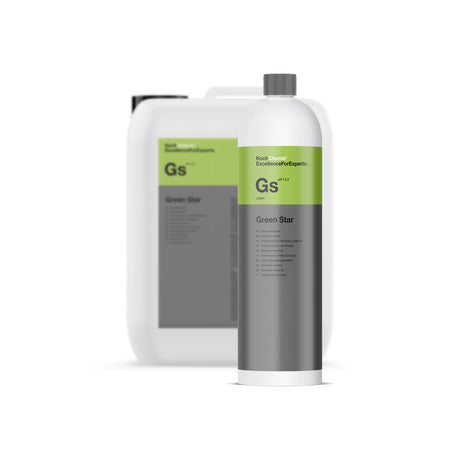
Both data sheets also require “Keep out of reach of unauthorised persons”. In a family garage that means: not at children's eye level, not next to the crate of drinks, not in walkways. The Green Star “Gs” with pH 12.5 carries this requirement too, even though it's filed under storage class 12, non-combustible liquids.
Frost is the smaller issue with the alkaline concentrates. Their data sheets call for “Store at room temperature” or “Store in a cool place”, and there is no “Protect from frost” for Vb, Mzr and Gs. That's good news for anyone with 10-litre canisters: they don't have to move into the living room. They do need a spot where they won't freeze solid in January, such as a shelf on an inner wall instead of the floor right by the door.
4. Next to the fan heater, solvent-based care becomes a fire risk
Solvent-based plastic care and glass cleaners are flammable liquids. Their winter storage risk is therefore not frost but the heat source many people use to keep the garage frost-free.
According to its safety data sheet, the Plast Star “Pss” from Koch-Chemie consists of 70 to 90 percent hydrocarbons and sits in storage class 3, flammable liquids. Section 7.2 requires “Protect from sunlight and heat” and “Do not store together with oxidising or self-igniting substances”. As conditions to avoid, section 10 lists heating, open flames, ignition sources and electrostatic charge.
This also covers products you wouldn't expect. The Glas Star “Gla” glass cleaner concentrate contains 10 to 20 percent each of ethanol and isopropanol and is in storage class 3, just like the Gummifix “Guf” rubber care. Both data sheets require protection from sun and heat. A good glass cleaner simply isn't water with a bit of soap, it evaporates streak-free thanks to the alcohol.
The fix: keep solvent-based bottles well away from the fan heater, the gas boiler and anything that throws sparks, so not right next to the charger and batteries of the polishing machine either. A shelf of their own at the other end of the room is enough. They usually take cold better than the emulsions from point 1, but not heat.
There's a contradiction here that is easy to run into in winter: if you put a small heater in the garage so the polish doesn't freeze, you'll quickly park it right in front of the shelf. That's good for the polish, but not for the plastic care in the compartment above it. If you take the emulsions indoors and store the flammable bottles cool but frost-free and far from any heat source, you solve both problems.

5. Diluted cleaners keep for less time than the concentrate
Shampoos, snow foam and cleaner concentrates come through storage in a closed original canister well, but the ready-diluted spray bottle next to it is a consumable that rarely gets through the winter unscathed.
The reason is protection against germs. Concentrates keep themselves fresh through high or low pH values, solvents or preservatives. Mix them 1:10 or 1:20 with tap water and you dilute that protection to a tenth or a twentieth, and germs come into the bottle with the water. How you spot it: after a few months the ready-to-use dilution smells musty or rotten instead of like cherry, and it cleans noticeably worse.
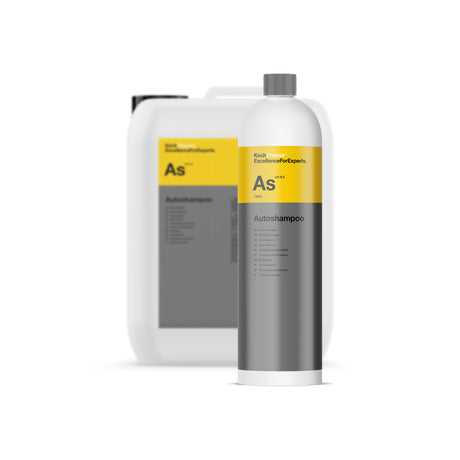
For the concentrates themselves the data sheets are consistent: Autoshampoo “As” with pH 9, Gentle Snow Foam “Gsf” with pH 7.5 and Ceramic Effect Shampoo “Ces” with pH 6 should be stored at room temperature and dry, only in the original container and tightly closed. A sealed canister usually lasts several years, an open one draws in moisture and dust.
A quick side glance at the car news of the day: whether it's the second-generation Tesla Roadster or the rendered saloon from the internet, according to the Tesla manual neither of them is going through a brush car wash. Tesla prescribes touchless washing or hand washing with a soft cloth and a mild car shampoo. So if you wash by hand in winter, you need a shampoo that hasn't spent December in the carport.
So only mix up as much ready-to-use dilution as you'll use within a few weeks, ideally with distilled water, and empty the spray bottles before the winter break. Don't put the canister on bare concrete by the door, but on a shelf or a wooden board. Ice takes up about 9 percent more space than water, and a full canister can split at the seams when it freezes through and then only starts dripping as it thaws.
Four helpers turn the canister into a tidy storage setup
If you want to store your car care products properly, start with the closed original canister, which is the safest way to store them. So that you don't have to unscrew and tip it for every wash, four parts help to make decanting clean, dosed and labelled.
The Outlet Tap for Koch-Chemie Canisters comes for 5- and 10-litre canisters. It replaces the cap, the canister lies on the shelf, and you fill up without lifting it. That saves spills, and the canister stays closed. Limit: it's made for the plastic canisters from Koch-Chemie, not for every other canister shape, and 5 and 10 litres each have their own variant. In one review the 5-litre tap didn't fit the 10-litre canister, so check the canister size before ordering.
The ready-to-use dilution goes into the HDPE Cylinder Bottle (28/400) Spray Bottle 1000ml. It carries a volume and dilution scale so you can mix 1:10 or 1:20 without a measuring jug. Label every bottle with the product, dilution and date. That way you know in spring what's inside and how old it is, and nobody mistakes it for a water bottle.
On top goes the Spray Head "Star" (28/400) CHS-3AN by Canyon, a chemical-resistant trigger with a continuously adjustable nozzle and about 1.2 millilitres per stroke. Limit: it's not a foam attachment, not meant for high pressure and doesn't fit 28/410 threads. Only screw it on hand-tight, as a head that's too tight warps the sealing lip and draws in air. Before the winter break, flush it through with clean water so nothing dries up in the nozzle.
The "Dosing Cap" dosing cap for 1000ml / 270mm bottles replaces the cap of the 1-litre concentrate bottle. One squeeze of the bottle and the concentrate rises through the 270 millimetre dip tube into a scale from 5 to 20 millilitres. Limit: it's not suitable for products containing acids or solvents and doesn't fit canisters from 5 litres up. So it belongs on shampoo concentrate, not on Fse or glass cleaner. On Trusted Shops it has 11 verified reviews.
You'll find more bottles and storage in the categories Spray bottles and Workshop equipment. If you're also winterising a pressure washer and foam sprayer, you'll find the routine in our article Storing your pressure washer frost-proof and the seal question in Foam sprayers for your car.

Detailing1-Insight: Before the first polish of spring we do a two-minute test that no data sheet describes. Shake the bottle for two minutes, put a pea-sized blob on a black microfibre cloth and rub it with your finger. If you feel grit or see a watery edge around the blob, the polish doesn't go on the paint any more, even if the bottle is still half full. The cloth shows you far sooner than a black bonnet under the machine.
No time for the whole post? Get it summarized:
Add Detailing1 as a preferred source on Google