5 wheel zones that each need a different wheel brush
Jasper von Detailing1 |


Dr. Wack "A1"
A1 "DER POLITUR SCHWAMM" Polishing sponge
Sponge for polishing by hand — dense foam, 150 x 80 x 35 mm
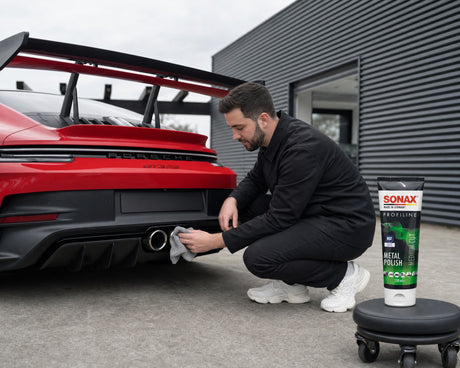
The same polish cuts hard on a wool pad and finishes fine on a soft one.
ZviZZer
Thermo Mini Pad "Ultra Soft" Thermo Foam Pad (Green)
Ultra-soft mini thermo foam pad for the finest spot finish
ZviZZer
Thermo Mini Pad "Soft" Thermo Foam Pad (Yellow)
Soft mini polishing pad, 10-pack, for tight spots and finishing
What does a polishing pad actually do? It carries the polish onto the paint, and through its material and hardness it decides how much you cut. Foam runs from a coarse sanding sponge to a soft finishing pad, wool cuts the hardest, microfibre sits in between. At Detailing1 you'll find pads from Koch-Chemie, SONAX, ZviZZer and Rupes.
Polishing pads are the working surface between machine and paint. They soak up the polish, pass the machine's pressure onto the panel, and through their material they decide how much clear coat you actually cut away. Foam pads cover everything from a coarse sanding sponge to a soft finishing pad; wool and microfibre cut beyond that. Without the right pad, even the best polish works below its potential.
Day-to-day from Detailing1: We get a lot of questions about holograms that show up in raking light after the last pass, even though a soft finishing pad was on the machine. The polish is rarely the culprit. Nine times out of ten the pad had already run over half the side of the car and was saturated with cut, so it smeared the panel instead of finishing it. Brush the pad out after every panel with the machine running, and lay out several pads for each step. A fresh pad costs less than the extra pass you'd otherwise have to make.
Cut comes from three things: the abrasive in the polish, the pressure pushing it into the paint, and the friction that builds up. Two of those three you control through the pad.
A firm, open-cell foam pad passes the machine's pressure onto the panel with almost no loss and holds the abrasive tight against the clear coat. A soft finishing pad cushions that same pressure, spreads it over more area and lets the abrasive glide across the surface rather than dig in.
In practice that means the same polish turns into scratch removal on a sanding sponge and into a finish on a soft pad. Day to day, a pad swap moves a polish about one grade in either direction, and that's the spread you work with instead of buying a separate bottle for every job.
This is where most customers save money, from what we see. If you've already got a medium polish on the shelf, a coarse pad and a soft pad get you further than a second and third bottle. The polishes range is then your fine adjustment, the pad the coarse dial.
The limit of that rule belongs in the picture too. A pad replaces no polish, it only shifts it. A pure finishing polish with very fine abrasive won't pull deep scratches out on a coarse foam pad; instead it drags a dull haze across the panel that you then have to work back off.
The reverse holds just as well. A cutting compound on a soft finishing pad cuts less but still leaves the marks of its coarse abrasive. Play one off against the other and you lose time. The combination decides it, and the order is always from the coarse pad to the fine one.
Every foam pad is polyurethane, and yet worlds lie between the coarsest and the finest. The difference sits in the cell structure.
Cell structure means the size and openness of the air pockets in the foam. Coarse, open cells form a bulky lattice with lots of sharp ridges that hold the abrasive and drag across the paint like countless little scrapers as the pad spins. Fine, closed cells give an almost smooth, giving surface. Rule of thumb: the coarser the cells, the more scratch depth you pull out in one pass, and the more rework you're in for afterwards.
At the top end sits the abrasive sanding sponge for the first cut. The Koch-Chemie Heavy Cut Foam Pad „Rot" is our best-selling pad here and belongs on weathered, deeply scratched paint where nothing happens without real cut.
The middle is where most cars actually get worked. The Koch-Chemie One Cut Foam Pad „Orange" is built as a medium-hard all-rounder for the one-step pass, the Koch-Chemie Fine Cut Foam Pad „Gelb" sits a grade below. On the SONAX PROFILINE ExzenterPad medium the same slot is simply called medium.
At the fine end you've got the anti-hologram and finishing pads. The Koch-Chemie Micro Cut Soft Foam Pad „Violett" lifts the last sanding marks out of dark paint, the Koch-Chemie Polish & Sealing Foam Pad „Grün" lays down finishing polishes and sealants without cutting any more itself.
One warning on the colours, because it causes trouble again and again: there's no colour code across brands. Red is the coarsest pad at one maker and a finishing pad at the next. Never go by the colour of a pad from another series, go by the name. We often see paint lose substance for no reason right here.
Some paint has even the coarsest foam sponge crawling. Hard clear coats off the German production line are among them, badly weathered panels too. That's when you switch material.
A wool pad works nothing like foam. Instead of a closed surface, thousands of individual fibres stand up off the backing, and every fibre tip is its own contact point on the paint. Air runs through between the fibres the whole time. Day to day you feel it twice over: the cut climbs sharply, and the panel still stays cooler than under an equally coarse foam pad.
The price for that is the rework. Wool leaves its own sanding pattern that stays visible in raking light as a fine web of scratches. So a wool pass is always followed by at least one more step with foam, otherwise you'll see the result again in the first bit of sun.
Microfibre pads are the newer compromise and were built for dual-action machines. Short, firm fibres on a foam core cut closer to wool but finish closer to foam. On big panels that saves you a whole step.
Their weakness is saturation. The fibre nap lies flat under heat and polish and clogs faster than any foam. A microfibre pad wants brushing out after every panel, otherwise it loses the very edge you bought it for within a few minutes.
Felt plays in its own league and doesn't work on paint. The SONAX PROFILINE FilzPad 125 is made for glass, where together with a glass polish it lifts wiper marks and fine etching out of the screen. On clear coat felt has no business — it's simply too hard there.
A polishing pad has a limited take-up, and it's reached quicker than most expect. After that it works against you.
What gathers in the cells is a mix of three things: unspent polish, removed clear coat, and abrasive that's been ground down during polishing. This paste fills the open chambers from the inside until the pad surface goes smooth and greasy. In practice: the cut collapses, the panel smears instead of clearing, and the heat climbs because the pad can't breathe any more.
The signs are clear once you know them. The polish spreads harder, the pad feels glassy rather than foamy to the touch, and a fine haze comes back in raking light that you'd only just cleared. By that point no further pass will save it.
The interim clean takes twenty seconds. Hold the pad against a pad brush at low speed, or blow it out with compressed air, or press it firmly into a dry microfibre towel. From what we see, one clean per panel is enough with foam, with microfibre more like twice per panel.
After the job the pads want washing, and soon. Cured polish you won't get out later. Lukewarm water, a mild cleaner, squeeze the pad out rather than wring it, because twisting pulls the foam off the hook-and-loop backing. Air-dry at room temperature, never on the radiator and never in the dryer.
At some point even a well-kept pad is done. The tells are frayed edges, a permanently shiny working face, and a hook-and-loop backing that's lifting off the foam in one spot. A pad that no longer sits flat spreads the pressure unevenly and turns into a hologram source. We'd swap it out then rather than drag it through another season.
The diameter decides two things at once: how fast you clear a panel and how aggressively the pad works in one spot.
For bonnet, roof and doors, 125 and 150 millimetres are the standard sizes. They cover plenty of area per pass and run smoothly. For mirror caps, A-pillars, bumper edges and the area around door handles you need small pads around 75 or 80 millimetres, otherwise you can't even reach the spot.
There's a link here a lot of people underrate: the same pressure spreads over far less area on a small pad. A 75 mm pad cuts noticeably harder with the same polish than a 150 mm one and also heats up faster. On narrow parts that's what you want; on a big panel you'll burn spots in with it.
The backing plate is the link to the machine and often gets bought as an afterthought. It has to be smaller than the pad — five to ten millimetres of overhang all round is the proven figure. Let the plate stand proud and its hard edge meets the paint on the first curve, and that damage runs deeper than anything you were about to polish out.
Centring matters just as much. A pad sitting crooked on the hook-and-loop throws the machine off balance, sends vibration into your wrist and cuts more on one side than the other. Set the pad on dead centre before every change and turn it through once by hand.
The machine sets the frame. Long-throw dual-action machines stall under pads that are too big; small pads there need a matching small plate so the throw runs clean at all. The Rupes „D-A" Intermediate (9.DA Series B), for instance, is matched to exactly this machine family. Which machine runs which throw is listed under polishers.
Three questions get you the answer: how deep the defects sit, how hard the clear coat is, and which machine you're on.
For light wash marks and dull gloss on a well-kept car, one pass does it. The Koch-Chemie One Cut Foam Pad „Orange" is built for that and delivers cut and finish in a single step. If you're staying in the SONAX system, grab the SONAX PROFILINE ExzenterPad medium for the same job.
For deeper scratches, weathering or a hard clear coat it runs over two steps. First the coarse cut with the Koch-Chemie Heavy Cut Foam Pad „Rot", then the anti-hologram pad. On dark paint that shows every mark, the Koch-Chemie Micro Cut Soft Foam Pad „Violett" is the second step; on hard paint you reach for the hard version of the same pad.
If a sealant's coming at the end, you need a pad that no longer cuts. The Koch-Chemie Polish & Sealing Foam Pad „Grün" spreads finishing polish and sealant evenly and leaves the freshly polished surface alone. A hard pad here undoes the last hour's work.
If it's your first time machine polishing, our advice is uncomfortable and right anyway: buy several pads of one hardness rather than one of each. On your first car a side takes longer than planned, and in that time a single pad saturates for sure. With a stack of matching pads the result stays consistent across the whole car.
That leaves the timing. You don't polish by the calendar but when scratches bother you in raking light, and always only after a full decon. An iron particle under the pad turns into a router and drags a mark clean across the panel. The full run from wash to sealant is under Polishing.
And if you're after how it all works together: the matching abrasives are under polishes, the drives under polishers, the overview of all three building blocks under Polishing. Of those, the pad is the part you change most often and take seriously least.
Too much choice in Polishing Pads? Get help picking:
Jasper von Detailing1 |

Daniel von Detailing1 |

Daniel von Detailing1 |

Daniel von Detailing1 |

Daniel von Detailing1 |

Daniel von Detailing1 |

Daniel von Detailing1 |

Daniel von Detailing1 |

Daniel von Detailing1 |

Jasper von Detailing1 |

Daniel von Detailing1 |

Daniel von Detailing1 |