
Remove tree sap and pollen within 48 hours
It is early June, the grasses are flowering, and overnight a yellow film settles on the paint again. Most people instinctively grab a cloth and wipe it off. That is exactly the moment a harmless pollen layer turns into lasting damage. Pollen and tree sap are not the real problem. The problem is the time you let pass and the way you react to it.
Removing tree sap and pollen from car paint is contactless and scratch-free within the first roughly 48 hours. After that, the clear coat begins to etch permanently. This guide explains why the limit sits at 48 hours and how to stay inside it.
Why June pollen and tree sap become a hazard now
Dry pollen sits harmlessly on the paint at first. It only becomes dangerous when moisture is added — morning dew, a short drizzle or an incorrect wash is enough to start the reaction.
Inside every pollen grain there are pectinases. These are plant enzymes whose natural job is to biochemically break down plant tissue so the pollen can germinate. When this enzyme meets the clear coat together with water, it starts doing the same work on the paint surface. In plain terms: as long as the pollen is bone dry, the clock is not ticking yet. The moment it gets damp, it starts to run — and that happens all by itself on a typical June morning with dew on the bonnet.
Alongside the pollen season, the sap season begins in early summer. Anyone parking under lime, maple or birch trees knows the sticky drops. Often it is not actual tree sap but honeydew — the sugary excretion of aphids sitting in the trees. Real tree sap consists of terpenes that harden into a rock-solid mass in the air. Both stick to the paint, both attract dust, and both get harder to remove with every hour of sun.
The current weather makes it no easier. The grass-pollen load is high right now, and the pollen flight is often followed by a short summer shower. This combination of pollen film and moisture is exactly the scenario in which a postponed wash turns into a paint problem.
After 48 hours the damage eats into the clear coat
Modern clear coat is a cross-linked polyurethane network that sits on the colour layer and protects it. In the first 24 hours this network only swells slightly under organic acid — after that the permanent etching begins.
Experts call the first phase swelling: the acid penetrates the polymer network and softens it at the surface, much like a sponge soaking up water. This is reversible. A contactless pre-wash within this window lifts the substance off, the paint recovers, no lasting damage. In practice that means anyone reacting within a day almost always gets away without consequences.
Once the dwell time exceeds about 48 hours, the reaction tips over. Swelling turns into etching — a true corrosion in which material is dissolved out of the clear coat. This is not an industry legend but measurable reaction kinetics: at summer temperatures the acids reach their critical penetration point after about 24 hours, and motoring clubs such as the German ADAC name the same span. What remains is a dull halo or a depression in the paint that can only be removed by machine paint correction, a fine wet sand or, in the worst case, a respray.
This transition often only becomes visible late. Fresh swelling disappears after the wash, while an etched halo stays put even after drying as a dull, slightly sunken spot that reflects differently in raking light than the rest of the surface. If you can feel the edge with a fingernail, you are already past the limit. Up to that point almost any pollen or sap damage can be removed without destruction — after it, the work starts with machine and abrasive. That is the whole reason these 48 hours matter so much.
With sap there is a second effect. As a sugar, honeydew draws water and keeps the surface permanently damp — ideal conditions for the acid reaction. Real sap, meanwhile, hardens and digs into the paint structure. Both therefore need the same fast reaction as pollen, just with a different tool at the end.

Pre-soak and pre-wash contactless instead of wiping dry
The most important rule of pollen season has just three words: no dry cloth. Every dry wipe over a pollen layer acts like fine sandpaper, because there is always mineral dust between the pollen and the paint.
The right sequence starts with softening. First the loose pollen is rinsed off with water — with a garden hose or a pressure washer at some distance, so nothing gets pressed into the paint. Then comes the contactless pre-wash with a Gentle Snow Foam „Gsf". The pH-neutral foam works at a value around 7.5, lays itself over the surface as a dense carpet and dissolves pollen and sticky honeydew while it dwells. How that works step by step is covered in detail in our guide to the contactless pre-wash.
Only after rinsing the foam off does the hand contact follow. Here the two-bucket method applies, with a pH-neutral care shampoo such as the Ceramic Effect Shampoo „Ces": one bucket with wash solution, one with clear rinse water, plus a soft wash mitt. Wipe in straight lines, not in circles — circular movements are the most common cause of the fine swirls you later see in raking light.
Anyone working in the shade and on cool paint has it twice as easy. Warm paint lets the water dry on faster and presses pollen deeper into the pores. An overcast morning is almost better for the pollen wash than bright sunshine.
The dwell time matters too. The foam may work for a few minutes but must never dry on the surface — as soon as it starts turning transparent, it gets rinsed off. Lukewarm water dissolves pollen and honeydew noticeably better than ice-cold, without stressing the paint thermally. And the wash mitt belongs back in the rinse bucket after every pass, so the washed-out dirt is not dragged across the next section. These three small things make the difference between clean and scratched.
These four products lift pollen and tree sap off the paint safely
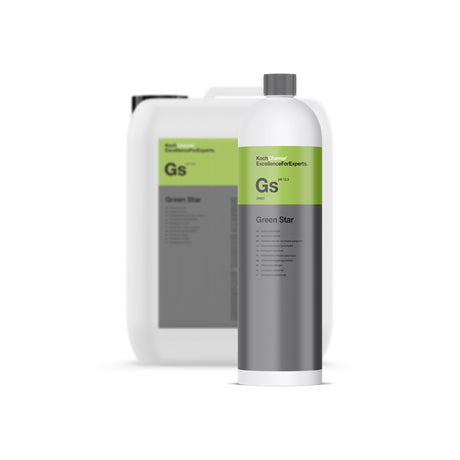
A staged set of four products covers the whole pollen and sap season: a pre-wash foam, a pH-neutral shampoo, a solvent for the tree sap and a quick detailer for the days in between.
It starts with the Gentle Snow Foam „Gsf" for the contactless pre-wash. It is wax- and sealant-compatible, so it does not attack an existing protective film — users confirm in over 15 verified Trusted Shops reviews that it works without trouble even on ceramic-coated vehicles. Its limit is named honestly: it is not meant for already baked-on insects or tar, which need an active cleaner. The follow-up care is handled by the Ceramic Effect Shampoo „Ces", which cleans at a neutral pH and builds a sealing effect on the side that makes the next load of pollen cling less. You will find both in the Snow Foam and pre-wash overview.
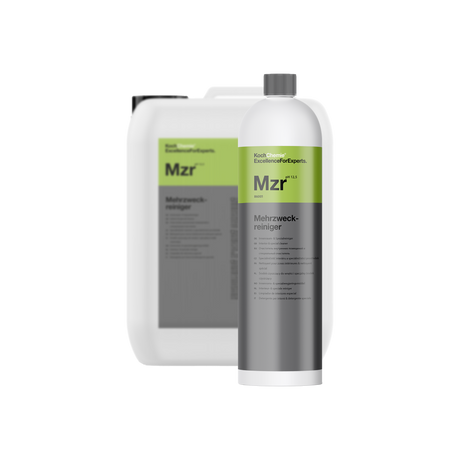
Removing hardened tree sap from car paint works with the Eulex „Eu" adhesive remover — baked-on honeydew gives up to it as well. It is made specifically for tree sap, adhesive residue, rubber and tar, works on all solvent-resistant surfaces such as paint, glass and metal, and evaporates residue-free. The pro trick is not to scrub it: instead of rubbing, you soak a cloth, press it onto the spot for a few seconds and then lift the dissolved sap off. That way the paint stays untouched.
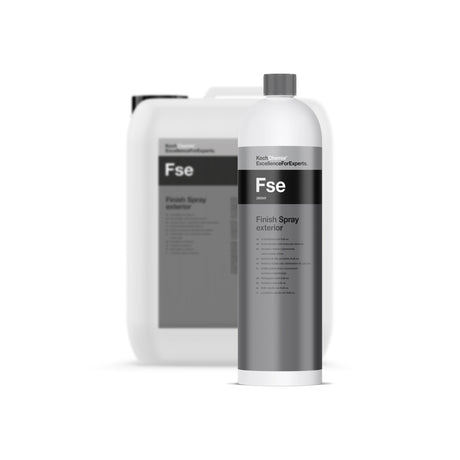
For a light pollen film between two washes and for the water spots a summer shower leaves behind, there is the Finish Spray Exterior „Fse". With its acidic Kalk-EX formula at a pH of around 2.5, the quick detailer dissolves mineral water spots in one step and seals with polymer wax. There is a limit here too: it has no place on a fresh ceramic coating or very fresh wax. We describe the matching workflow in our article on the quick detailer between washes; you will find more sprays under Quick Detailer.

These mistakes turn pollen into deep scratches
Most paint damage in pollen season is caused not by the acid but by the reaction to it. Dry wiping, home remedies and the heat gun do more harm in the end than the pollen itself.
The classic is the dry wipe with a hand or a paper towel across the dusty bonnet, just to see whether there is still gloss underneath. In that moment the mix of pollen, sticky sap and dust acts like sandpaper and instantly creates fine scratches that, in the worst case, reach down to the primer. Just as harmful is the dry wiper system over a pollen-covered windscreen: the rubber lips take damage and permanent streaks stay in the glass.
Anyone reaching for harsher means makes it worse. The rough side of a scouring sponge or a splash of scouring cream scratches the clear coat over a wide area and dulls it — damage that can only be polished out. Acetone or nail-polish remover against sap is risky too, because they can attack the clear coat.
The most stubborn myth concerns the sap: many are advised to heat hardened tree sap with a heat gun or hairdryer. Technically that is the opposite of helpful. The heat drives the last volatile components out of the sap so it bakes on glass-hard for good, expands the clear coat underneath at the same time and accelerates the acid reaction. The ADAC explicitly warns against it too. Removing tree sap from car paint works with the right solvent and a little patience, never with heat.

How the paint survives the next pollen season
An intact sealant turns the pollen problem into pure maintenance. On a protected surface neither pollen nor sap really gets a grip, and on the next foam pass you simply rinse both off.
The lever is a closed protective layer. Anyone who seals the paint before the main season or uses a care shampoo with a sealing effect builds an anti-stick level on which the enzymes dock less easily. That does not move the 48-hour limit, but it makes the wash afterwards much faster and gentler — the decisive difference between a quick foam-off and tedious soaking.
On top of that comes the routine. In peak season a short, contactless wash every one to two weeks beats the big programme once a month, because nothing then reaches the critical dwell time in the first place. And whoever has the choice does not park directly under lime or maple trees in early summer — otherwise the honeydew comes back faster than any sealant can hold it off.
In terms of effort, this route is also the easier one. One litre of pre-wash foam and one litre of care shampoo cover a complete pollen and sap season, while a single machine paint correction devours many times the time and material. Care in small, regular steps almost always beats the one big rescue operation at the end — with the paint just as with the rest of the car.
In the end the whole pollen season is a question of reaction time. Anyone who reads the yellow film as a signal and reacts contactless within two days carries the paint through the summer without a single scratch.
Detailing1 insight: From our hands-on practice we almost never see the damage caused by the pollen itself, but by the quick check-wipe with a finger across the dusty bonnet. Do the press test instead: on a hard sap spot, first lay a cloth soaked in Eulex on it for ten seconds, then check whether the spot already lifts with a gentle pull. If it does not come away by itself, soak it a second time rather than scratch — one wipe too early costs you a whole polishing round later.